Mario, the most famous plumber of all, celebrates his 40th birthday
, by Quentin
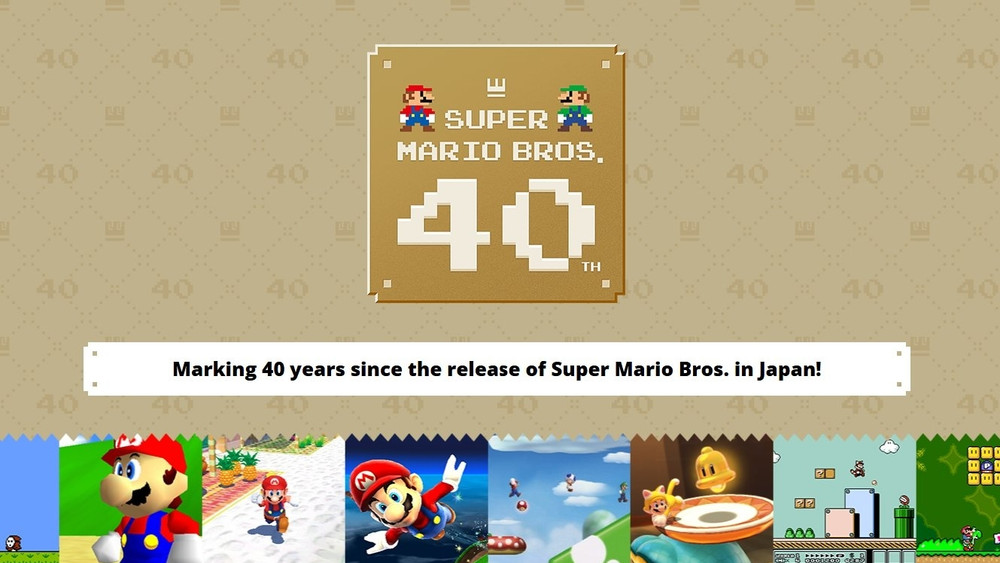
This kind of birthday doesn't happen every day, and for good reason: he is one of the most iconic characters in the world of video games. We are, of course, talking about Mario.
Nintendo's beloved mascot is celebrating his 40th birthday this September, with plenty of surprises in store for gamers. These include a compilation of Super Mario Galaxy + Super Mario Galaxy 2 on Nintendo Switch, Mario Tennis Fever, Yoshi and the Mysterious Book, a Nintendo Switch 2 version of Super Mario Bros. Wonder, or finally a trailer for the movie Super Mario Galaxy scheduled for release in April 2026—a new cinematic adaptation after an extremely high-quality first installment. The latter will also be directed by Illumination Studios.
A character who has always known how to reinvent himself to best navigate the ages
The secret to Mario's longevity lies in several factors. First, of course, is the fact that he arrived at the right time, at a time when video games still had everything to prove. Despite first appearing in 1981 in the arcade game Donkey Kong, where he was nicknamed Jumpman and had to rescue a woman held captive by the famous gorilla, it was in 1985 that he really made his mark on the industry with the arrival of the hugely popular Super Mario Bros. on NES.
That year, Shigeru Miyamoto gave players a rich universe and a platform game that was extremely easy to pick up. He took players to the Mushroom Kingdom and introduced them to Princess Peach and her arch-enemy, Bowser. Of course, we can't forget his brother, Luigi, who is just as beloved by fans.
At that time, Nintendo reinvented the platform game and breathed new life into the genre, with levels containing secret areas and high replayability. Super Mario Bros. also features legendary music, with Kōji Kondō's theme, which still resonates 40 years later.
Mario continued to perfect his world and gameplay in subsequent titles, such as Super Mario Bros. 3 in 1988 and Super Mario World. But to continue to shine as brightly as it did on day one, Nintendo had to be able to offer new experiences and take a concept that could quickly become tiresome to the next level.
This would be the case in the Nintendo 64 era with the first 3D episode: Super Mario 64. This title would quickly become the benchmark for designing a good 3D platformer, and would have a significant impact on the entire industry.
It reinforced its lore, refined its gameplay mechanics, and went much further by offering an experience that had never been seen before. It was a resounding critical and commercial success, and Shigeru Miyamoto created one of his greatest masterpieces. The game has also stood the test of time, as its gameplay is still very much present in modern games.
Nintendo continued along this path in the following years, not hesitating to try new things, as was the case with the much-maligned Super Mario Sunshine, which again offered new ways to play, but which confused early players while appealing to others. But the developers also delivered a colorful, fun game to accompany the company's new console: the GameCube.
This was again the case with Super Mario Galaxy on Wii in 2007, which sent us straight into space with a unique universe, taking advantage of the capabilities of the Wiimote and Nunchuck to perform certain actions using your actual movements.
Alongside 3D episodes such as Super Mario Odyssey, Nintendo will never abandon the initial experience with titles closer to the original formula and 2D games, as was the case with Super Mario Bros. Wonder, which we highly recommend. But if its recipe for success wasn't based solely on that...
A bankable hero with a thousand and one facets
Mario is a family star, capable of inviting himself into your living room and inspiring young and old alike. You can invite your grandparents to play Mario Party with you or go karting in Mario Kart.
But our plumber is also a top athlete, notably in Mario Tennis, Mario Golf, and Mario Strikers for soccer. He doesn't deny himself anything, not even participating in the Olympic Games with Mario & Sonic at the Olympic Games.
These are experiences that may make you smile, but they are also what gives the franchise a new lease on life and allows Nintendo to continually reinvent itself without ever denying its core expertise.
These side entries sell millions of copies—as in the case of the aforementioned Mario Party and Mario Kart—figures that are in no way inferior to the main titles in the series.
Furthermore, the franchise as a whole has sold more than 950 million units worldwide, making it the biggest franchise of all time. The Super Mario series alone has sold 465 million copies.
Another striking figure: the first installment, Super Mario Bros., whether through its original NES edition or its re-releases, has sold over 53 million copies.
Even more impressive: Mario Kart 8 Deluxe has sold over 68 million copies—and if we add the Wii U version, that number rises to 76 million. Such figures prove the almost unique power of our plumber, and lead us to believe that he alone will be able to transcend generations again and again.
Of course, some figures should be taken with a grain of salt, as they are based on analysts' estimates. Nintendo communicates very little on this subject, so we can't just consider them completely reliable.
What is your experience with Mario player? What is your favorite game, and which one has made the least impression on you? Tell us in the comments below!