Interview with Jacques Exertier (Beyond Good & Evil, King Kong, Prince of Persia: The Lost Crown) Part 2
, by Quentin
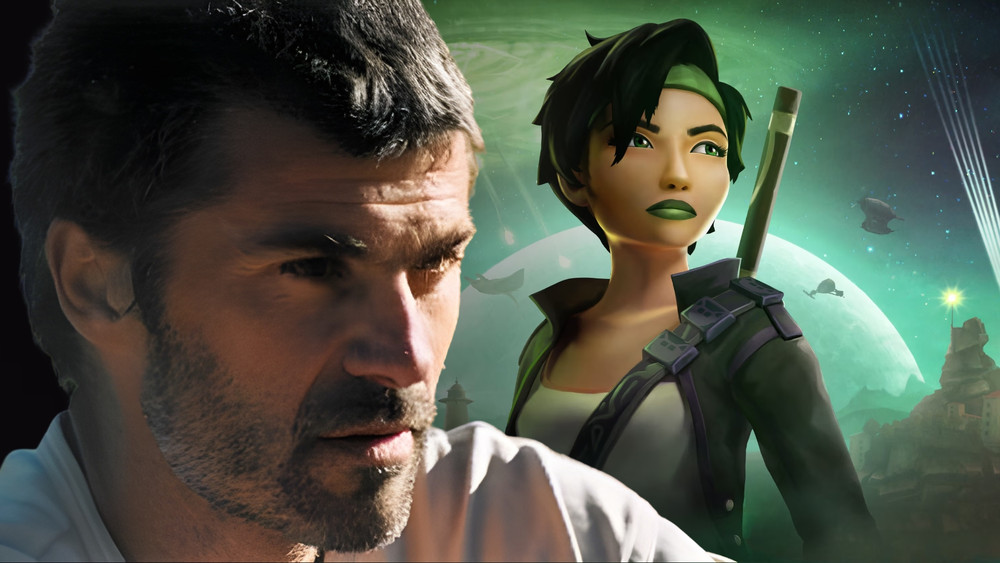
Last week, we published the first part of this interview, in which we went over Jacques Exertier's great career. This week, we continue this interview with further questions, notably on Beyond Good & Evil and Prince of Persia: The Lost Crown.
Let's also talk about Beyond Good & Evil. What inspired you to imagine the
characters and the universe? Did you draw on any references from movies, books or elsewhere?
After Rayman 2: The Great Escape, there was a time when we wanted to make an adventure game a little more mature than Rayman. Well, mature may not be the right word... Let's say with a deeper story.
At one point, we were even working on a prototype based around Merlin the Enchanter - whom we thought of as a young man - but in the end it didn't work. We then went back and forth between different ideas, until we finally said: OK, it’s Beyond Good & Evil we want to make.
One of the first ideas Michel and I shared was the desire for a somewhat ecologist background. This was already a thing in Rayman, because these are the values that constituted us. We didn't consciously say to ourselves, "Hey, we're going to make a game about ecology”. It just seemed natural and obvious. And then there was the desire to create a strong female character, but that goes for non-violent means of action.
That's where the idea of the camera came from. And it was this choice that led to other themes: propaganda, the authoritarian system, media manipulation… Everything gradually built up from there.
As for references, there are quite a few. For example, Pey'j is clearly reminiscent of Miyazaki's Porco Rosso- that's pretty obvious. And in early versions of the game, we also felt a strong Dark Crystal influence. The first concept arts were very close to it, perhaps even a little too much, so we changed it later on.
There was also Alien, and more broadly Giger's work, which inspired us - especially in the final part of the game, when we arrive on the Moon. Here, the visuals are clearly marked by his work.
At the end of Beyond Good & Evil, the post-credit scene clearly teased a sequel. Back on 2003, when you finished developing the game, what direction would you have liked the sequel to take? Where would you have liked to take the characters? Did you already have any ideas or avenues for development at the time?
No, at the time they were just bits and pieces. There were quite a few elements in there where we felt there was real narrative potential, unspoken areas that we had yet to explore exploited. We said to ourselves, "We'll see, we'll figure it out.
Not everything was written in advance. We didn't have twelve detailed episodes under our belts, but that was also a good thing: it left material and doors open for a possible sequel.
There are things we couldn't do in the first game. Originally, there were supposed to be several planets, and even a few zones on Hillys. But we were limited in terms of time, budget and production capacity.
In the end, we had just one planet - plus the Moon, which we only pass by very quickly. There also had to be real encounters with the Dom'zs, not just the final boss, but we didn't have the time to do them as we intended.
And then, as is often the case at the end of a production, you hit the deadline wall and ask yourself the terrible question: “Well, what do we cut?”. These are difficult moments, because you have to make compromises between what you want to do and what you can actually deliver. But in a way, it's also what leaves avenues to explore for what comes next. That which you couldn't do before becomes narrative potential for tomorrow.
King Kong isn't your only title based on a movie, since you also worked on The Adventures of Tintin, a film directed by Steven Spielberg. Did you have a chance to meet or talk with him? Was he involved in development? And do you have any anecdotes to share about him?
When Steven Spielberg released the first Indiana Jones in the early 80s, several European journalists told him they saw a sort of link between Indiana and Tintin. But Spielberg didn't know Tintin at the time.
So he wanted to find out what it was all about... and he loved the universe so much that he immediately bought the rights for a possible adaptation. He said to himself, ”I've got the rights, one day I'll make a movie.”
He renewed those rights for years, until the project finally saw the light of day with The Secret in the Universe, in 2011. He was adamant that it be a 3D film, and he effected quite a few technical tests with Weta, Peter Jackson's studio. That's how they met and became friends.
Ubisoft then suggested we adapt the film into a video game. So we went back to work with Peter Jackson, in New Zealand, and with Spielberg in Los Angeles. As this was also their first collaboration, there was a great deal of respect between them. We regularly traveled between the United States and New Zealand to get their approvals.
We had to check every detail with several people to ensure that everyone was satisfied. As far as the script was concerned, we were faced with a particular problem. Usually, games adapted from films are generally released before the films, to benefit from the promo.
So for us, the deal was clear from the outset: the game was to be released three weeks before the film. But we learned that we weren't allowed to reveal certain key elements of the script.
For example, one of the big twists in the film is that Rackham the Red is in fact a descendant of Sakharine - something that doesn't exist at all in Hergé's comics. In the original, there is no link between these two characters. But we weren't allowed to talk about them in the game. In fact, even the studio had a problem with this in their own communication.
It was Daniel Craig who played both Sakharine and Rackham the Red. He voiced and did the motion capture of both characters, but they were very discreet about it. We knew he was part of the cast, but we didn't know exactly what role he played.
So we were faced with a complex situation: we had to follow the story of the film… without being allowed to use the main villain. We could include Rackham the Red in sequences from the galleon era, but not his descendant in the contemporary era. And above all, we weren't allowed to say it was Sakharine.
So we decided to go back to the comics: we put the spotlight back on the Loiseau brothers, the comic-book villains, who were just gone on the film. In the end, we did the game adaptation”... but with a different villain altogether.
You have to realize that often the production order between a movie and a game isn't the same. We needed to start the animations very early, to know what Tintin was going to look like - at least in terms of proportions - to anticipate the work. We didn't know whether he would be realistic or stylized. We'd ask: “Can you send us the models of Tintin, Haddock, etc.?” And we were told, “No, we're not there yet, we're still looking at it.”
So we started working with unfinished versions, trying to anticipate... And when we finally received the real models, we had to readapt everything.
Finally, let's talk about your latest title with Prince of Persia: The Lost Crown. What challenges did you face in telling an engaging story while allowing the freedom of exploration typical of the metroidvania genre?
On Prince of Persia: The Lost Crown, I was in charge of the narrative. But what was new for me was the non-linear aspect of a metroidvania. Well... not entirely. There are, after all, narrative nodes that we know are inescapable, and through which the player must pass. But between these nodes, there's no way to anticipate what the player will do, or in what order.
So we wrote the game on three levels. Firstly, you have a linear narrative skeleton: the major story milestones, which are fixed and are triggered in a precise order. This is what keeps the structure clear, even in an open world title.
Then you have narrative elements that the player must receive at a given moment, but you don't control the order in which they appear. You know that the information will eventually reach him,but you don't know when. So you have to write these elements in such a way that they remain understandable, regardless of the order in which they are discovered.
And finally, there's a third level: side stories. Stories hidden in side quests or secret areas. With these, you know that only the most curious or skilled players will come across them. You have to write those knowing that most players won’t find them.
Sometimes, the same dialogue has several versions depending on what the player has done before. But we can’t cover everything either, it would be too much. So we make sure that dialogues are formulated in a way that they remain correct whether the player has beaten a certain boss or not, for example.
And that was something really new for me. All the games I’d worked on up to that point were much more linear.
Did you have to make any compromises in terms of story to keep up with the demands of the metroidvania gameplay experience, or did you find ways for the two aspects to feed on each other?
Sadly, you can never fully achieve what you aim for. So yes, there are bound to be compromises. In fact, I have an anecdote on this subject, which illustrates just how close storytelling and game design need to be.
Originally, among the powers Sargon could acquire was one called “Ubiquity”. With this power, you could create a double of yourself, and switch between the two Sargons at will. We found this interesting, both in narrative and mechanical terms. But after several tests, we realized that, from a gameplay point of view, it just wasn't working. It was neither fun enough, nor different enough from the other powers. So we ended up abandoning the idea, and came up with a simpler variation - present in the game, but in a very different form altogether.
Except that the script itself had been conceived around this concept. A whole part of the story had to lead up to this idea of merging with a double of oneself. And so, when we realized that the gameplay wasn't keeping up, we had to adapt everything. We said to ourselves: “Well... the gameplay for this thing just doesn't work.” But that's normal, it happens all the time. You have to be infinitely flexible. A video game script isn't something you write in your corner, then put down on the table and say, “There, that's the script.” It doesn't work like that at all.
You have to constantly adjust, rewrite and test. Because in the end, the gameplay and the scenario carry the story in equal measure.
What are your future projects now, and what can we ask you for a sequel?
Well, I'm still at Ubisoft, but I'm not going to risk talking about the project I'm currently working on - I'm very bad at that, I always speak a little too early and say things I shouldn't say (laughs).
All I can say is that I'm having a great time, and I'm lucky enough to work on projects that are never the same. I was lucky enough, for example, to work on a game like Prince of Persia: The Lost Crown, where I was able to be both animation director and narrative director.
So yes, it's probably a mistake to wear several hats because it requires a lot of work... but honestly, today, I'd have a hard time choosing between the two roles.
In this interview, we discover not only a talented creator, but also a lucid professional, capable of juggling narrative ambitions with technical constraints. His outlook on video games, his humility in the face of compromise and his constant curiosity make him a valuable voice on the French video game scene.
What's next? He's still keeping a low profile, but one thing's for sure: whatever the project, he will continue to explore new playing fields, where storytelling and gameplay can still reinvent themselves.